An LP token is what you receive when you deposit tokens into a liquidity pool — proof of your share of that pool, and the key that lets you withdraw your portion later. Understanding what it actually represents (and what yield farming does with it) matters before treating it like just another tradeable asset.
{{IMAGE:assets/images/lp-featured.webp}}
What an LP token represents
When you deposit an equal value of two tokens into a liquidity pool, the pool’s smart contract mints you a corresponding amount of its own LP token, representing your proportional claim on everything in the pool — both tokens, plus your share of the fees the pool has earned. As the pool’s composition shifts from trading activity (see impermanent loss, explained for what that shift can cost you), your LP token’s underlying value shifts with it, since it always represents a percentage share rather than a fixed amount of either token.
How you get one (and how you redeem it)
You receive an LP token automatically at the moment you deposit into a pool — no separate step is required. To exit, you return the LP token to the pool’s smart contract, which burns it and pays out your proportional share of the pool’s current token balances (not necessarily the same ratio of tokens you originally deposited, because of the rebalancing covered in the impermanent-loss article above).
Yield farming: staking your LP token for more
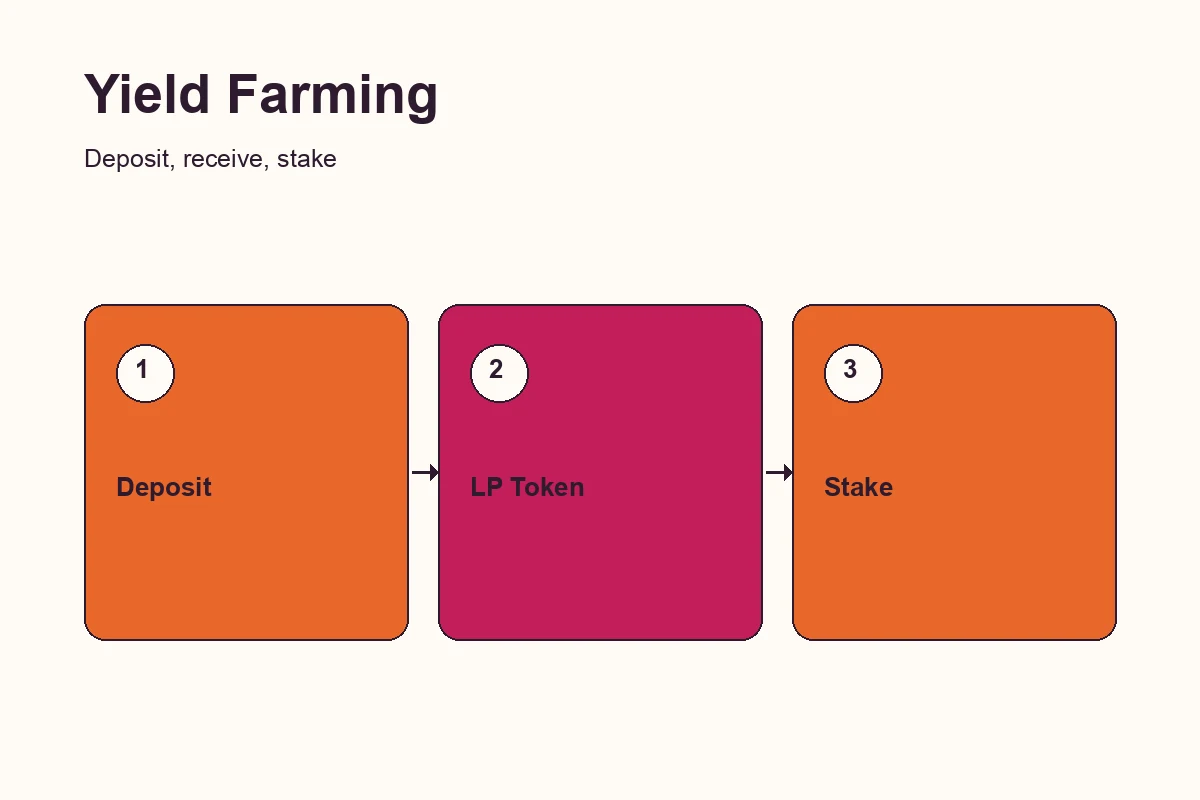
Many protocols let you take the LP token you received and stake it in a separate contract to earn additional rewards on top of the pool’s own trading fees — commonly paid out in that protocol’s own governance token. This practice is usually called yield farming. It’s an extra layer built on top of liquidity provision, not a separate, independent activity — you still need to be a liquidity provider (and take on impermanent loss) to have an LP token to farm with in the first place.
{{IMAGE:assets/images/lp-farming-process.webp}}
LP tokens aren’t interchangeable across protocols
An LP token from one protocol’s ETH/USDC pool is not the same asset as an LP token from a different protocol’s ETH/USDC pool, even though both represent a claim on a similarly composed pair. Each is minted by, and redeemable only through, the specific smart contract that created it — you can’t deposit a token from one protocol’s pool and redeem it through another’s. This matters when comparing yield-farming opportunities across protocols: the LP token itself is part of what you’re evaluating, not just the reward rate quoted on top of it, since it determines which staking contracts will even accept it.
Using an LP token as collateral
Because an LP token is itself a transferable asset representing real underlying value, some lending protocols accept it as collateral for a loan — letting a provider borrow against their pool position without fully exiting it. This adds yet another layer on top of everything already covered: if the LP token’s underlying value falls (from impermanent loss or a broader market move) enough to threaten the loan’s collateral ratio, the position can be liquidated, on top of whatever impermanent loss and staking-contract risk already applied. Each additional layer compounds the ways the position can lose value, not just the ways it can gain.
The layered risk this adds
Staking your LP token adds risk on top of what providing liquidity already carries:
- The underlying pool’s impermanent loss — still applies, since your LP token’s value still tracks the pool’s actual composition.
- The staking contract’s own smart-contract risk — a separate contract from the pool itself, with its own potential for bugs or exploits.
- The reward token’s own price risk — farming rewards are frequently paid in a newer, more volatile governance token, whose value can fall independently of anything happening in the underlying pool.
None of this makes yield farming inherently a bad idea — but it means the headline reward rate reflects compensation for a genuinely larger stack of risk, not a bonus on top of a safe baseline.
Tracking your position over time
Because an LP token’s redemption value floats with the pool’s actual composition rather than staying fixed, it’s worth periodically comparing what your position is currently worth against what the same tokens would be worth if you’d simply held them instead — the gap between the two is your impermanent loss (or gain) at that moment, not a number most wallets surface automatically. This matters most before making a decision to withdraw, since that’s the point the comparison actually becomes relevant to a real choice rather than a background curiosity.
FAQ
Can I sell my LP token to someone else instead of redeeming it?
In many protocols, yes — LP tokens are often themselves transferable or tradeable, though whoever holds it at redemption time is the one who receives the underlying pool assets.
Does holding an LP token protect me from impermanent loss?
No. The LP token represents your share of the pool exactly as it exists, including whatever rebalancing has already happened — it doesn’t shield you from that mechanism.
Is yield farming the same thing as providing liquidity?
No — providing liquidity is depositing into the pool and receiving an LP token; yield farming is the additional, optional step of staking that LP token elsewhere for extra rewards.
What happens to my LP token if the underlying pool is drained by an exploit?
The LP token’s redemption value follows whatever is actually left in the pool’s smart contract — if an exploit removes assets from the pool, the token’s redeemable value falls accordingly, since it represents a proportional claim on the pool’s real contents, not a fixed guaranteed amount.
For how the pool your LP token represents actually works in the first place, see our liquidity pool overview.