A liquidity pool is a reserve of two (or more) tokens locked in a smart contract that lets traders swap between them without needing a matching buyer or seller on the other side. It’s a different flavor of the same basic idea behind a bitcoin mining pool: a mining pool combines many miners’ hashpower so rewards arrive steadily instead of depending on rare solo wins, while a liquidity pool combines many users’ capital so a trade always has somewhere to go instead of depending on a matched counterparty. Both trade individual scale for collective participation — just with a different resource being pooled. This page walks through how that actually works, and what you’re taking on if you decide to provide liquidity yourself.
What a liquidity pool actually is
Instead of a traditional order book matching individual buyers and sellers, a liquidity pool holds a stock of two tokens (say, ETH and USDC) inside a smart contract. Anyone can trade against that stock at a price the contract calculates automatically. Anyone can also deposit an equal value of both tokens into the pool and become a liquidity provider (LP), earning a share of the trading fees every swap generates in return.
In practice, you’ll usually meet a liquidity pool without ever thinking about it directly: whenever you swap one token for another on a decentralized exchange, you’re almost certainly trading against one. The pool’s contract address, its current token balances, and every trade that’s happened against it are all publicly visible on-chain — there’s no hidden order flow or internal matching engine the way there is on a centralized exchange. That transparency cuts both ways: anyone can verify a pool’s real balances before trading against it, but it also means a pool’s contract code is exactly as trustworthy as whoever wrote and audited it, and nothing more.
How an AMM prices trades
The software that calculates the price is called an automated market maker (AMM). The most common model is the constant-product formula, usually written x × y = k: multiply the quantity of token A by the quantity of token B in the pool, and that number (k) must stay the same after every trade. When a trader swaps token A into the pool, the pool’s token A balance goes up and its token B balance has to go down to keep the product constant — and that shift in balance is what determines the price the trader gets.
| Step | Pool ETH | Pool USDC | Product (k) |
|---|---|---|---|
| Before a trade | 10 | 20,000 | 200,000 |
| After someone buys 1 ETH from the pool | 9 | ~22,222 | ~200,000 (held constant) |
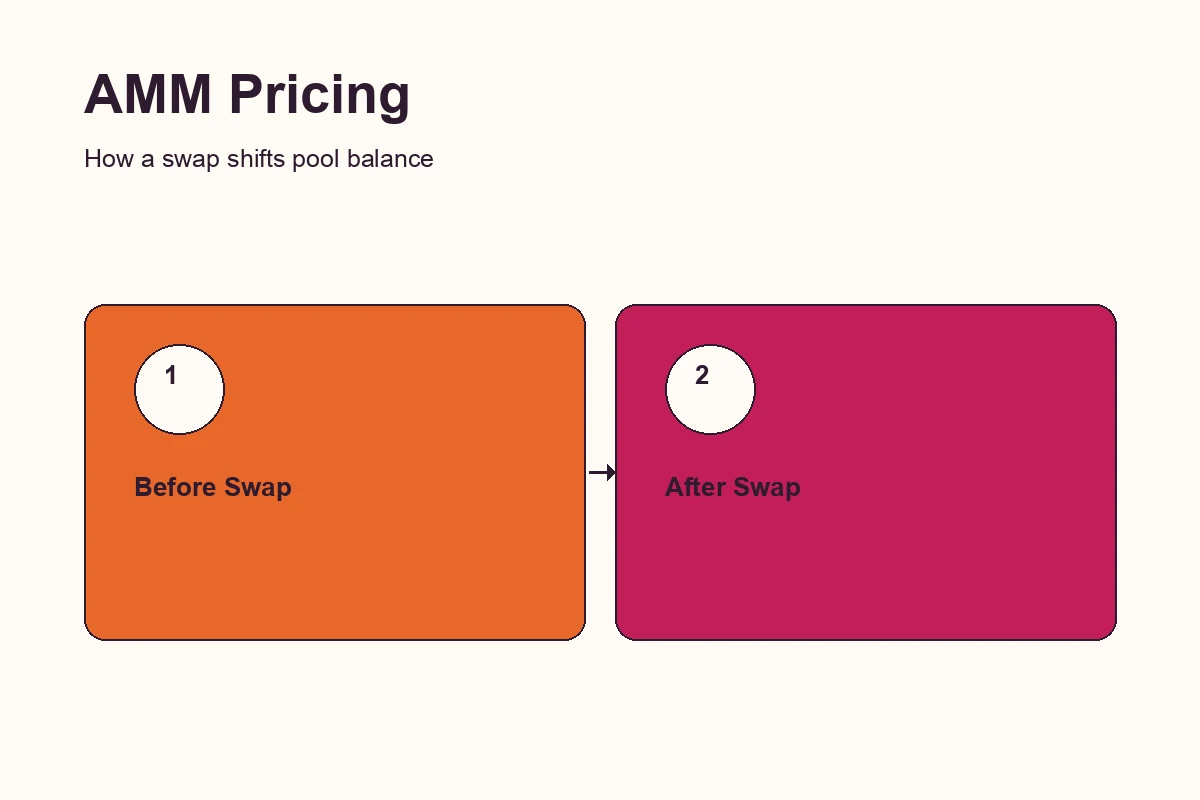
This is a simplified, illustrative example, not a live market snapshot — the exact numbers move with every trade on a real pool. For the full mechanism, including why larger trades move the price more than smaller ones, see how automated market makers actually price trades.
Not every pool works the same way
The 50/50 constant-product design above is the most common shape, but it isn’t the only one. A few variants you’ll encounter:
- Standard (50/50) pools — equal value of two different tokens, priced by the constant-product formula above. Works for any pair, but produces the most slippage and impermanent loss when the two assets’ prices diverge.
- Stableswap pools — tuned for assets expected to trade near a fixed ratio, like two different stablecoins or a token and its wrapped version. Much lower slippage and impermanent loss for that specific use case.
- Weighted pools — allow ratios other than 50/50 (say, 80/20), letting a provider keep more exposure to one asset while still earning fees.
All three use the same underlying idea — a formula that recalculates price from pool balance — just tuned differently for different asset relationships.
What you get for providing liquidity
In exchange for locking up capital, liquidity providers typically earn a proportional share of the trading fees generated by swaps in that pool, and receive an LP token representing their claim on the pool. Fee rates aren’t universal — a pool’s fee tier is usually set by the protocol or chosen by whoever created the pool, and different fee tiers suit different asset pairs: a highly liquid, low-volatility pair can support a lower fee and still attract volume, while a more volatile or thinly traded pair often needs a higher fee to make providing liquidity worthwhile at all. Some protocols let providers stake that LP token elsewhere for additional rewards — a practice usually called yield farming. See what LP tokens are and how yield farming builds on them for the full picture.
The real risk: impermanent loss
Providing liquidity is not free yield. If the price ratio between the two pooled tokens changes after you deposit, the pool’s constant-product rebalancing can leave you with less total value than if you had simply held the two tokens separately — a cost called impermanent loss. It’s called “impermanent” because it can shrink back to zero if the price ratio returns to where it was when you deposited; it only becomes a real, realized loss if you withdraw while the ratio is still different. Kraken’s own explainer walks through the mechanics in more depth. For the full breakdown with a worked example, see impermanent loss, explained.
Smart-contract risk is separate from price risk
Impermanent loss is a market-mechanics risk — it exists even if the pool’s code works exactly as intended. On top of that, every liquidity pool is a smart contract, and smart contracts can contain bugs or be exploited, which is a separate category of risk entirely. Providing liquidity to an unaudited or unproven protocol adds this risk on top of impermanent loss, not instead of it. CoinGecko’s liquidity-pool guide covers this alongside the mechanics in more detail.
An independent code audit reduces this risk but doesn’t eliminate it — audits catch known categories of bugs, not every possible one, and a protocol can still be exploited after being audited. A large total value locked (TVL) in a pool is sometimes treated as a trust signal, but it’s really just a measure of how much capital other people have already deposited — useful context, not proof of safety on its own.
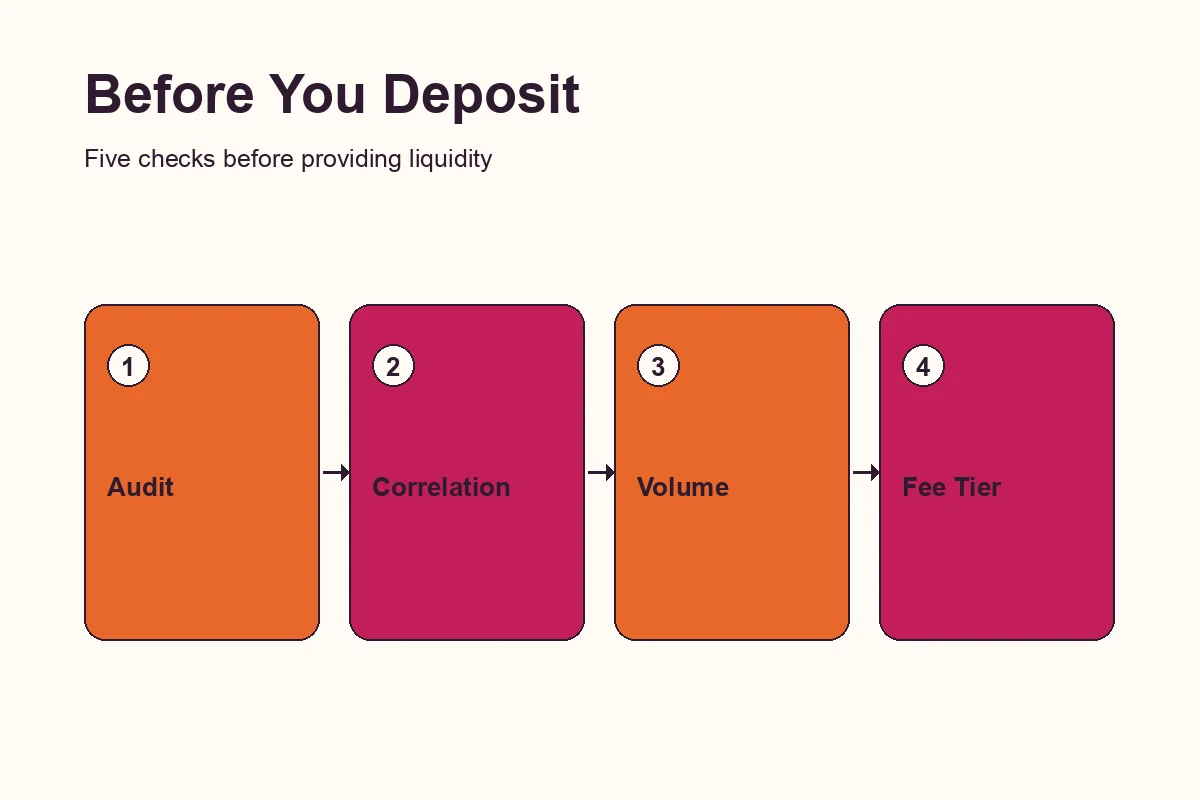
How to evaluate a pool before providing liquidity
- Check whether the protocol has been audited, and by whom — a reputable, named auditor is a stronger signal than an unnamed or self-reported one.
- Look at how correlated the two assets are. Two stablecoins, or a token paired with its own wrapped version, carry far less impermanent-loss exposure than two unrelated tokens.
- Check recent trading volume relative to the pool’s size — that’s what actually drives the fee income that can offset impermanent loss over time.
- Understand the fee tier you’d be earning, and how it compares to similar pools for the same pair elsewhere.
- Only deposit an amount you’re comfortable seeing fluctuate in value relative to simply holding the two tokens — per the impermanent-loss risk covered above.
FAQ
Do I need to be a liquidity provider to use a liquidity pool?
No — most people who interact with a liquidity pool are simply trading against it (swapping one token for another), not depositing capital into it. Only those who choose to deposit tokens become liquidity providers.
Is impermanent loss guaranteed to happen?
No. It only occurs if the price ratio between the two pooled tokens moves after you deposit. If the ratio is unchanged when you withdraw, there’s no impermanent loss to realize.
Can trading fees offset impermanent loss?
Sometimes, yes — fee income is the main reason to provide liquidity despite the risk, and in a high-volume pool it can outweigh the loss. Whether it does depends on trading volume and how much the price ratio actually moved, which varies pool to pool.
Are all liquidity pools equally risky?
No. Pools pairing two assets that tend to move together (like two stablecoins) generally see far less impermanent loss than pools pairing two assets with very different price behavior.
What happens to my tokens while they’re in a pool?
They’re held by the pool’s smart contract and used to facilitate trades; you don’t control the exact ratio of the two tokens while deposited, since that ratio shifts as trades happen against the pool.
Does a bigger, more established pool mean it’s safer?
A larger, longer-running pool has typically been battle-tested by more real trading activity and often belongs to a more established protocol, which can be a reasonable signal — but size alone doesn’t guarantee an audit was done well or that the code is bug-free.
Can I withdraw from a liquidity pool at any time?
In most standard AMM pools, yes — there’s typically no lock-up period, and you can redeem your LP token for your proportional share of the pool’s current balances whenever you choose. Some yield-farming or staking layers built on top of a pool may impose their own separate lock-up terms, though.